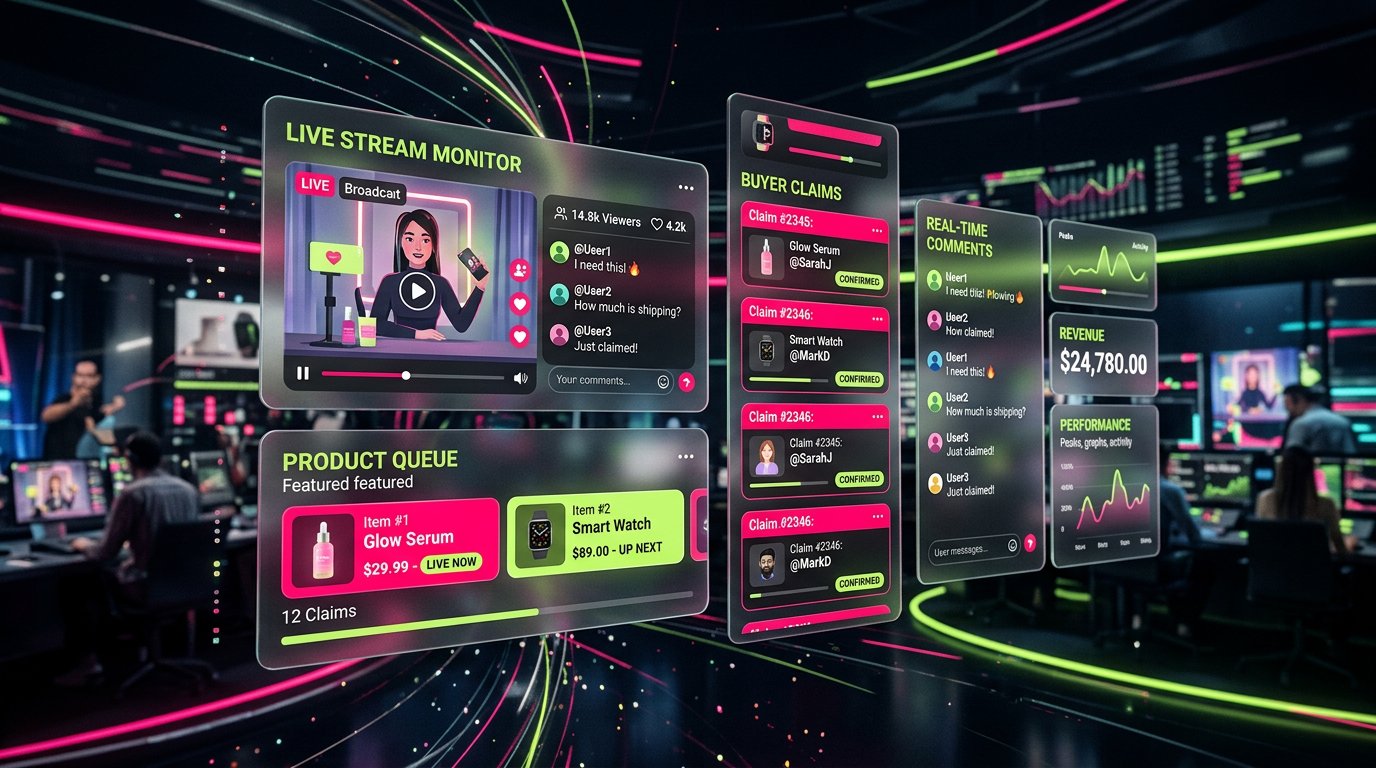
Spend an hour watching a TikTok Live or Facebook Live selling session and you will see the streaming infrastructure work flawlessly. Video stays up. Comments scroll past. Reactions land. The platform's job is done.
Then watch the seller's side. Spreadsheets open in three tabs. A handwritten list of products. A messenger thread coordinating with the warehouse. Someone in another window manually tallying buyer comments by timestamp. The streaming part is solved. The operations part is not.
The five problems
- Run sheets live in someone's head or a spreadsheet — products get presented out of order, things get skipped.
- Buyer claims from comments get missed, duplicated, or awarded to the wrong person.
- Inventory gets oversold because two staff are confirming the same item in parallel.
- Winners-to-orders is a manual copy-paste from comments into a Google Sheet into the order system.
- Post-session reporting means cobbling numbers from the platform dashboard, the warehouse system, and the seller's memory.
None of these are streaming problems. All of them are operations problems. Which is what Live Selling OS is built to solve.
The Live Director
The Live Director is the run sheet, made interactive. Queue products before the session. Set the active product with one click — the customer-visible overlay updates, the host's prompter updates, the inventory locks. Move through the queue, track what has already been presented, never lose your place.
The claim engine
For platforms whose APIs allow it, the system ingests comments, detects product codes and claim keywords, sorts claims by exact platform timestamp, and produces a ranked list of buyer candidates. The unclear ones (typos, ambiguous text) get escalated to a moderator for one-tap resolution.
Stock-lock reservations
When a claim is confirmed, the variant is locked for that buyer for a configurable window. Duplicate claims fail loudly. Expired locks release automatically. It is the simplest pattern in the system and it eliminates the single biggest source of customer complaints in live selling.
Why this is the right shape
The platform does not try to replace the streaming layer. It does not try to host video, manage RTMP, or fight TikTok or Meta for the broadcast. It sits one level up, where the streaming platforms do not want to be, and turns the chaos around a live session into a workflow.
Live commerce is not a streaming problem. The streaming problem was solved years ago. The operations problem is wide open.