The default move in vertical SaaS is to swallow the industry. Pick a sector — dental, restaurants, real estate, logistics — and try to replace every tool the customer already uses. The result, almost without exception, is a product that is competent at twenty things and exceptional at none.
I went the other way with Dentra.
The narrow question
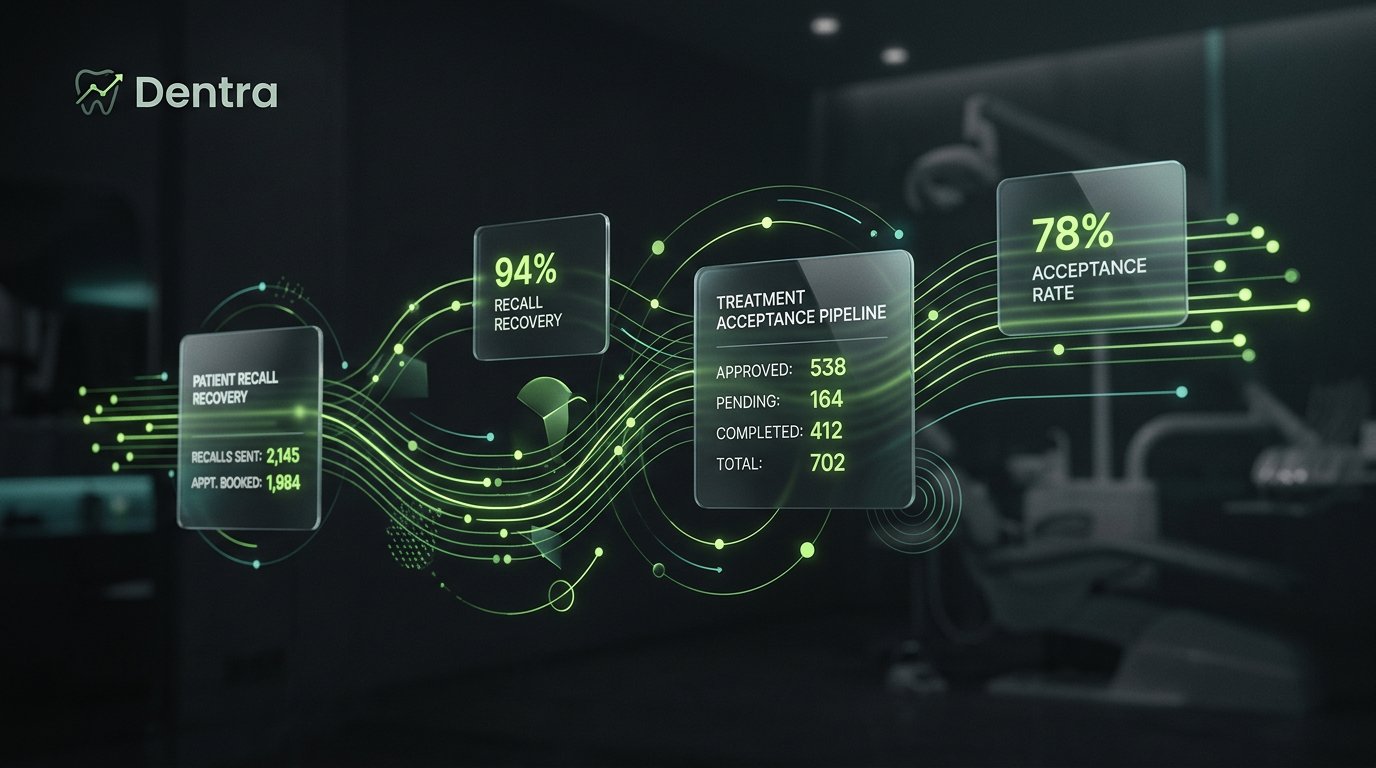
Dental clinics already have practice-management software. They have appointment books, billing systems, X-ray viewers, patient records. Replacing any of those is a five-year war I have no business starting. So I asked a different question: what is the single most expensive thing a dental clinic does poorly?
The answer turned out to be two things, not one:
- Overdue patient recalls. Patients become due for routine cleanings and never come back, because nobody follows up consistently.
- Treatment-plan acceptance. A dentist diagnoses work, the patient walks out to "think about it," and the case is never properly followed up.
Both lose the practice real money every month. Both are fixable with a focused workflow. Neither needs me to replace the existing practice-management system.
The wedge is not the small product. The wedge is the small product that wins because it refuses to be the big one.
What this unlocked
Choosing two workflows instead of twenty had downstream effects on every architectural decision:
- The data model shrank to twelve entities I can actually reason about: workspaces, clinics, users, patients, recall cases, treatment opportunities, tasks, comms, appointments, subscriptions, audit logs.
- The API surface stays small enough to document fully. No 400-endpoint nightmare to maintain.
- The onboarding pitch is one sentence: "We help you recover overdue recalls and lift treatment acceptance — keep using your existing system for everything else."
- The scope of an audit log is actually achievable, because there are only so many things a user can do.
Multi-workspace from day one
Even though the product is narrow, the SaaS shape is real. Workspaces own clinics, clinics own patients and cases, users belong to workspaces with roles. Role-based permissions, subscription gating, and audit logs are baked into the schema from the first migration — not bolted on later when the first agency-tier customer asks for them.
The monorepo shape
Four apps in the workspace: web (the main user product), admin (system-level admin), api (backend services), worker (background jobs and async). Shared packages for ui, types, database, and env validation. The worker tier is the one I see new SaaS skip — reminder emails, recall-due jobs, communication-status syncs all want a worker.
Why this ships
Every architectural decision becomes easier when the product knows what it is not. I do not have to design a billing engine, an X-ray storage backend, a clinical notes editor, an insurance-claims pipeline. Each of those is somebody else's product, and Dentra is happy to integrate with them later rather than rebuild them now.
The unfashionable truth about vertical SaaS is that the products that win are usually the narrow ones. Calendly did not start as "all of scheduling." Linear did not start as "all of project management." The wedge is not a phase you pass through on the way to being big — it is the thing that makes you possible at all.